✅ Pass MOT Test: 15 Tips to Ensure Your Car Passes the MOT First Time
The annual MOT test doesn’t have to be a source of stress. While the test itself is unpredictable—as it relies entirely on your car’s condition—the vast majority of MOT failures stem from simple, preventable issues that you can check and fix at home. Failing the MOT means re-booking, extra cost, and the inconvenience of being unable to drive the vehicle legally (in most cases). Therefore, applying proactive tips to pass MOT test is essential.
This comprehensive guide gives you actionable tips to pass MOT test on your first attempt. We cover the most common failure points, providing a step-by-step pre-MOT checklist to help you ensure your car passes the MOT first time and keep your vehicle safe and compliant.
Part 1: Lighting & Electrics (Essential MOT Preparation Tips)
Lights account for a significant percentage of all MOT failures, and they are usually the simplest things to fix yourself. Consequently, you must use these MOT preparation tips to check your car’s electrics before you attempt to pass MOT test.
1. Check All Exterior Lights
-
Test Procedure: Turn on the ignition and ask a friend (or use a reflective surface like a garage door) to check every light bulb.
-
Lights to Check: Inspect headlights (dipped and full beam), side lights, brake lights (including the high-level centre light), indicators (front and rear), rear fog light, and reverse light (if fitted).
-
The Plate Light: Ensure your rear number plate lights work. A failed plate light is a common and cheap failure, easily preventing you from being able to pass MOT test.
2. Wipers and Washers
-
Wiper Condition: Are the blades cracked, split, or leaving smears? If so, replace them.
-
Washer Fluid: Top up the screen wash reservoir. Furthermore, a failure to clear the screen when washing is an instant fail. Ensure the washer jets are correctly aimed.
3. Horn Check
Give the horn a quick blast. Crucially, it must be easily audible and functional for your vehicle to pass MOT test.
Part 2: Wheels, Tyres, and Brakes (Critical for Passing the MOT Test)
Tyres and brakes are critical for safety and are heavily scrutinized during the MOT test. Therefore, these tips to pass MOT test should be checked thoroughly.
4. Tyre Tread Depth and Condition
-
Legal Minimum: The legal minimum tread depth is 1.6mm across the central three-quarters of the tyre, around the entire circumference.
-
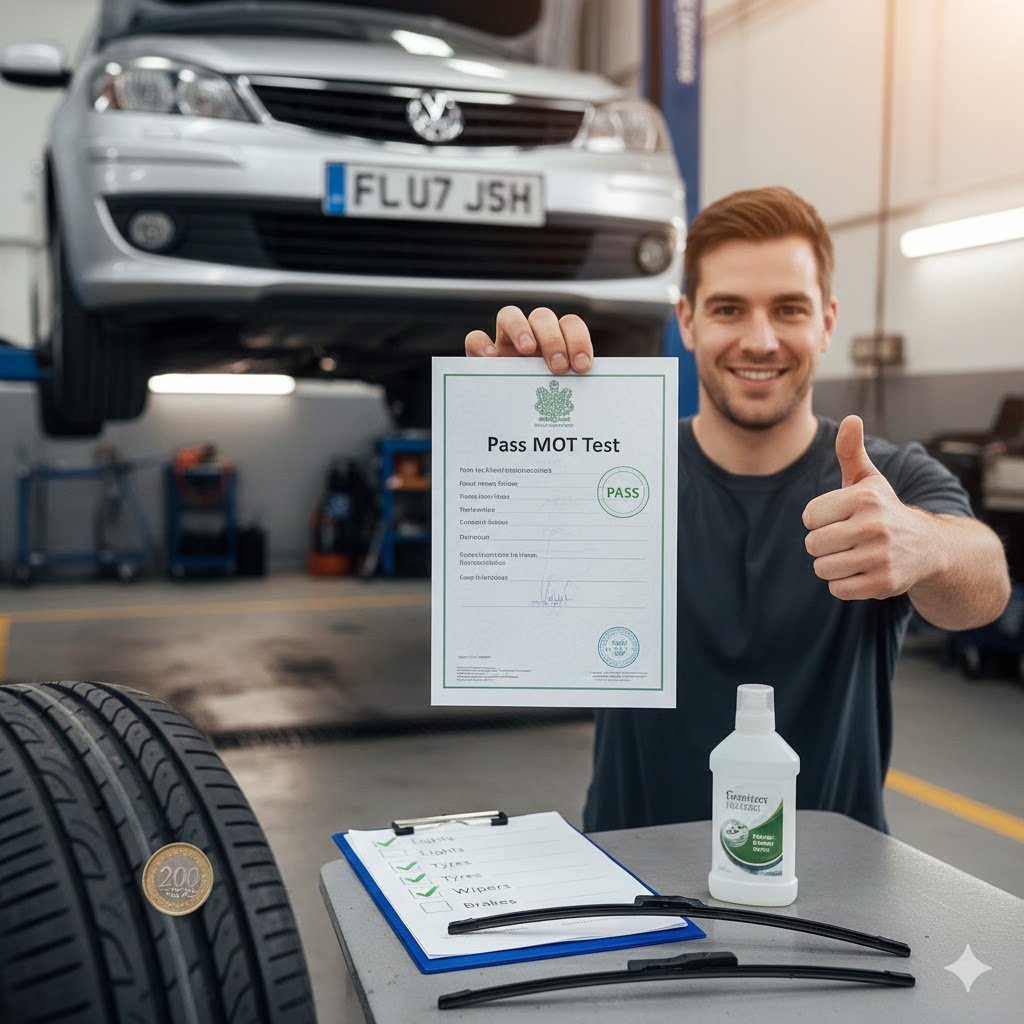
The 20p Test: Place a 20p coin into the main tread grooves. If the outer band of the coin is visible, your tread may be illegal, and you need new tyres. Undoubtedly, this is a common reason cars fail the MOT Test.
-
Damage Check: Look for any bulges, cuts, or tears on the sidewalls. These are immediate fail points.
5. Tyre Pressure
Ensure all tyres are inflated to the manufacturer’s recommended pressure (found inside the driver’s door jamb or in the owner’s manual). Correct pressure can contribute to a better result when you pass MOT test.
6. Wheel Nuts
Ensure all visible wheel nuts are present and appear secure.
7. Brake Fluid
Check your brake fluid reservoir level. It must be between the minimum and maximum markers. If the level is low, it indicates wear or a leak, which requires professional inspection before you try to pass MOT test.
Part 3: Body, Interior, and Visibility to Pass MOT Test
These parts cover the structural integrity and the driver’s ability to safely control the car, all crucial for passing the MOT Test.
8. Fuel and Oil
-
Fuel: The tank must have enough fuel for the engine to run during the emissions test.
-
Oil: The oil level must be sufficient to prevent damage and ensure a proper emissions reading. In fact, low levels can lead to an incorrect MOT test result.
9. Dashboard Warning Lights
If the ABS, Airbag, Engine Management Light (EML), or Electronic Power Steering (EPS) warning lights are illuminated on your dashboard, your car will automatically fail the MOT. Consequently, you must have any warning lights diagnosed and fixed before the test. This is one of the most vital tips to pass MOT test. For more details on common warning lights, consult the RAC guide to dashboard symbols
10. Number Plates
-
Cleanliness: Ensure your plates are clean and readable.
-
Legality: They must be securely fixed and conform to legal size, font, and spacing rules for you to pass MOT test.
11. Seatbelts
Tug firmly on all seatbelts (front and rear). Specifically, they must:
-
Be securely attached.
-
Retract fully when released.
-
Not be frayed or damaged.
12. View of the Road
Any significant damage or cracks in the windscreen that obstruct the driver’s view (in the A-zone) will result in a failure. Furthermore, any damage larger than 40mm anywhere on the screen is a fail. This is a crucial area to check to ensure your car passes the MOT first time.
Part 4: Suspension, Steering, and Emissions (Professional Checks for Passing the MOT Test)
While some checks need a lift, a few simple actions can still help ensure your car passes the MOT first time.
13. Steering and Suspension
You can test steering for looseness by gently turning the wheel left and right while parked. Also, listen for clonks or knocking over speed bumps, which often indicates worn suspension joints (a common MOT failure).
14. Exhaust and Emissions
-
Check for Leaks: Listen for unusual loud noises or blowing sounds from the exhaust.
-
Warm-up: To give your car the best chance of passing the emissions test, take it for a good 20–30 minute drive at motorway speeds just before the test. This action warms up the engine and catalytic converter, making the emissions reading cleaner. This crucial step can greatly aid your efforts to pass MOT test.
15. The MOT Records History Check
Review your car’s previous MOT records (you can do a free MOT check on the GOV.UK website). Look at the ‘Advisories’ section. If you ignored an advisory last year, ensure that item has been fixed this year, as the tester will focus on those areas. For a step-by-step guide on checking your history, see our post on Check Car MOT History Online [Internal Link 1]. You can access the official MOT history check tool directly on the GOV.UK website [Outbound Link 2: Link to GOV.UK Check MOT history page].
Use Your Pre-MOT Checklist and Drive Confidently
By following this pre-MOT checklist and investing an hour of your time, you can address the vast majority of reasons cars fail the MOT Test. Ultimately, taking these simple tips to pass MOT test will not only save you money on re-tests but, most importantly, ensure your car passes the MOT first time and remains safe for you and your passengers.
When it comes time to book, choose a trusted MOT centre that offers transparent service. For this reason, for advice on finding a reliable garage, read our guide on Finding the Best MOT Garages Locally
Good luck, and happy motoring!