There is nothing worse than turning on your AC on a hot summer day and getting a blast of warm air. But in 2025, a car air conditioning regas is about more than just driver comfort.
As we move towards 2026, the rules and technologies are changing. Did you know that in modern Electric Vehicles, the air conditioning system is responsible for keeping the high-voltage battery safe? Or that choosing the wrong gas type can be physically impossible due to different port sizes?
In this guide, we explain the difference between R134a (Old) and R1234yf (New) gas, why the cost difference is so high, and why a working AC system is critical for avoiding breakdowns in 2026.
1. Which Gas Do I Need? (The 2017 Rule)
When you book a car air conditioning regas, the first question we ask is: “What year is your car?” This is because of a strict environmental law change.
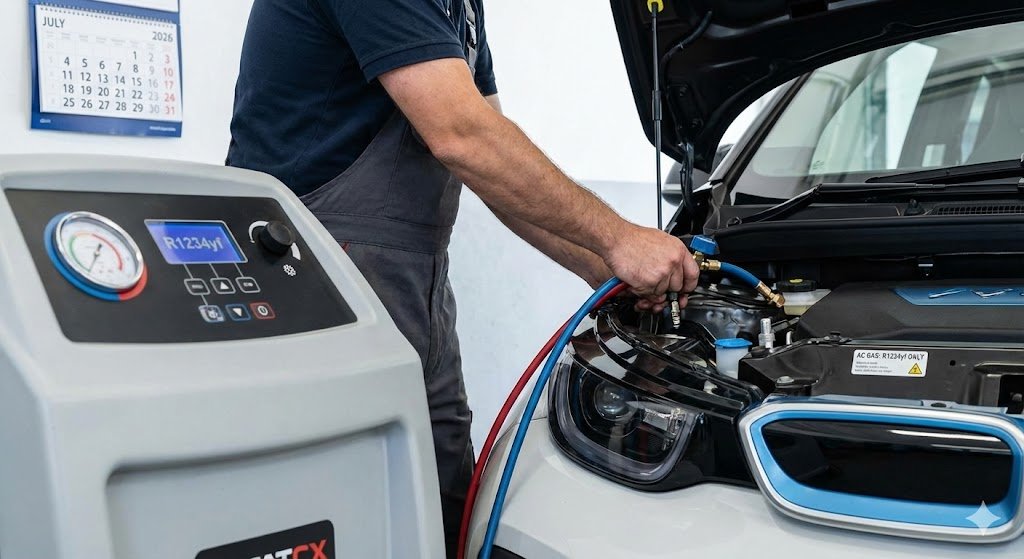
R134a (The “Old” Gas)
-
For: Most cars manufactured before January 1, 2017.
-
Status: It is still legal to use for older cars, but it is being phased out because it has a high “Global Warming Potential” (GWP).
-
Cost: Cheaper, but prices are rising as supply becomes scarcer.
R1234yf (The “New” Gas)
-
For: All cars manufactured after January 1, 2017 (and some late 2015/2016 models).
-
Status: Environmentally friendly with a very low GWP. It breaks down in the atmosphere in just 11 days (compared to 13 years for R134a).
-
Cost: Significantly more expensive due to complex manufacturing and patents.
Can I choose the cheaper one?
No. The service ports are physically different sizes. You cannot put old gas in a new car (and doing so is illegal).
2. Car Air Conditioning Regas Costs (2025/2026)
Why is your quote higher than it was five years ago? The shift to R1234yf has impacted prices across the UK.
| Gas Type | Vehicle Age | Average UK Cost (2025) |
| R134a | Pre-2017 | £60 – £95 |
| R1234yf | Post-2017 | £130 – £200+ |
Why the price jump?
The new R1234yf gas is currently manufactured by a limited number of suppliers globally. While we expect prices to stabilize by 2026, it remains a premium product compared to the old standard.
3. The 2026 Risk: EV Battery Cooling
This is the most important update for 2026. If you drive an Electric Vehicle (EV) or Hybrid, your AC system is critical for reliability.
The “Thermal Management” Link
In an internal combustion car, the AC just cools you. In an EV, the AC system cools the High Voltage Battery.
-
The Danger: If your AC runs out of gas, the battery cannot cool itself during rapid charging or motorway driving.
-
The Result: The car will reduce power (“Turtle Mode”) or refuse to Supercharge to protect the battery.
The 2026 Advice: For EV owners, a car air conditioning regas is now a mechanical necessity, not just a luxury. Neglecting it could leave you stranded at a charger.
4. 5 Signs You Need a Regas
Don’t wait for the system to fail completely. Look for these early warning signs.
-
Warm Air: The obvious one. The vents blow ambient temperature air instead of ice-cold air.
-
Slow Demisting: In winter, the AC dries the air to clear the windscreen. If your screen stays foggy for minutes, you are low on gas.
-
Hissing Noise: A “snake-like” hiss from the dashboard usually means the gas is low and struggling to flow through the expansion valve.
-
Musty Smell: This isn’t low gas; this is bacteria. You need an anti-bacterial clean (often an add-on to the regas service).
-
Engine Labours: If your engine revs drop significantly or the car feels sluggish when AC is on, the compressor might be seizing due to lack of lubrication (the oil is mixed with the gas).
5. Frequently Asked Questions (FAQ)
Here are the most common questions regarding car air conditioning regas services.
1. How often should I regas my car?
Manufacturers recommend every 2 years. Your system loses about 10-15% of its gas annually through natural porous seals.
2. Is AC checked during the MOT?
No. The MOT tests safety (brakes, lights), not comfort. Your AC can be completely broken, and you will still pass.
3. Why does the new gas cost so much?
R1234yf is a complex chemical that is harder to produce and safer for the ozone layer. The cost reflects the manufacturing complexity.
4. Can I buy a DIY regas kit?
We strongly advise against it. If you overfill the system, you can blow the seals or destroy the compressor (a £600+ mistake). Professionals weigh the gas to the exact gram.
5. Does AC affect fuel consumption?
Yes. A working AC uses fuel/battery. However, a system low on gas has to work harder, using even more energy to achieve the same cooling.
6. My car is a 2016 model; which gas does it need?
2016 is the “crossover” year. Check the sticker under your bonnet, or contact us. It could be either R134a or R1234yf.
7. Can I mix the two gases?
Absolutely not. They are chemically incompatible and will damage the system.
8. Why is my EV not charging fast?
If your AC is broken, the car limits charging speed to prevent the battery overheating. Check your AC gas levels!
9. Does a regas fix leaks?
No. If you have a leak (e.g., a hole in the condenser), the new gas will escape in days. We perform a “vacuum test” before filling to check for major leaks.
10. Is it illegal to have no gas in my AC?
No, it is not illegal, but it will lead to expensive repairs later as the internal seals dry out and crack without lubrication.
Conclusion: Stay Cool, Protect Your Battery
Whether you want to stay cool in a traffic jam or ensure your EV battery charges at full speed, a car air conditioning regas is a vital maintenance task for 2026.
Don’t wait for the first heatwave (when prices often spike due to demand). Check your system now.
Warm Air Blowing?
Don’t sweat it. Get a Quote for a precision R134a or R1234yf regas today.
For tips on maintaining your AC system in winter, see our Car Care Tips on Pinterest.