It is the repair every driver fears. Unlike a flat tyre or a blown bulb, a snapped timing belt doesn’t just stop your car; it destroys your engine. If you are searching for a timing belt replacement, you are likely worried about the cost or the age of your vehicle.
As we approach 2026, this maintenance is becoming critical for millions of UK drivers. Why? because cars registered in 2016 (a boom year for car sales) are about to hit their 10-year “danger zone.”
In this guide, we explain exactly when you need a timing belt replacement, the difference between a belt and a chain, why you should always change the water pump at the same time, and how to avoid a £3,000 engine bill in 2026.
1. What is a Timing Belt and Why Does It Snap?
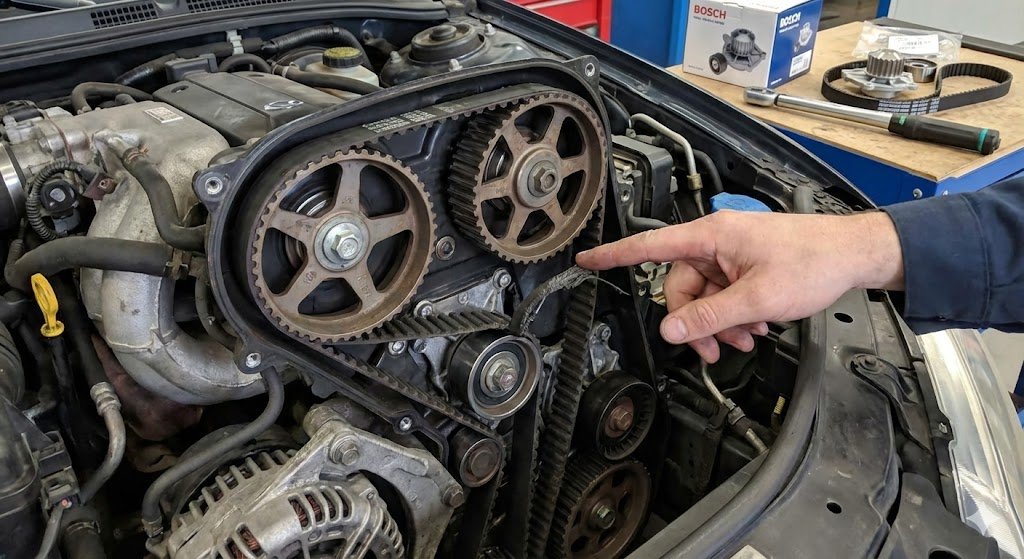
The timing belt (or cambelt) is a toothed rubber belt that synchronizes your engine. It ensures the valves open and close at the exact moment the pistons move up and down.
The “Interference” Danger
Most modern engines are “interference engines.” This means the pistons and valves share the same space, just at different times.
-
If the belt works: They dance perfectly together.
-
If the belt snaps: The pistons smash into the valves at 3,000 RPM. The result is bent valves, shattered pistons, and a destroyed engine.
The Solution: A scheduled timing belt replacement is the only way to prevent this. There is usually no warning before it snaps.
2. When Do I Need a Timing Belt Replacement? (The 2026 Rule)
Manufacturers have strict intervals for changing the belt. However, these are often misunderstood.
The “Mileage vs. Age” Rule
You must change the belt based on whichever comes first.
-
Mileage: Typically every 60,000 to 100,000 miles.
-
Age: Typically every 5, 7, or 10 years.
The 2026 Warning: The 10-Year Trap
Many popular UK cars (like Ford EcoBoosts or VW Golfs) have a “10-year / 100,000-mile” interval.
-
The Risk: If you bought a “16-plate” car (registered in 2016), your 10-year deadline arrives in 2026.
-
Rubber Degrades: Even if your 2016 car has only done 30,000 miles, the rubber belt is 10 years old. It is brittle and ready to snap. Do not ignore the age limit.
3. Timing Belt Replacement Cost in the UK (2025/2026)
A timing belt replacement is not cheap, but it is 80% cheaper than a new engine.
Average Costs
Prices vary wildly depending on the complexity of the engine.
-
Small Petrol Car (e.g., Fiat 500): £250 – £400
-
Medium Car (e.g., Ford Focus): £400 – £600
-
Large Diesel/SUV (e.g., Audi A4): £550 – £850+
Why is it so expensive?
The belt itself is cheap (£40). The cost is in the labour. To access the belt, a mechanic often has to strip down the entire side of the engine, remove engine mounts, and lock the camshafts with specialist tools. It is a 3-6 hour job.
4. The “Water Pump” Question
When you get a quote for a timing belt replacement, the garage will almost always ask: “Do you want the water pump changed too?”
The Answer is YES.
-
Why? In most cars, the water pump is driven by the timing belt. To change the pump later, you would have to do the entire timing belt job again (paying the labour twice).
-
The Risk: If you put a tight new belt on an old, weak water pump, the extra tension often causes the old pump to seize. If the pump seizes, it snaps the new belt, destroying your engine.
-
The Cost: Adding a water pump typically adds only £40-£60 to the bill. It is a no-brainer.
5. Timing Belt vs. Timing Chain
Does your car even have a belt? Some cars use a metal Timing Chain.
-
Timing Belt: Made of rubber. Needs replacement every 5-10 years. Quieter.
-
Timing Chain: Made of metal (like a bike chain). Designed to last the “life” of the car. No replacement schedule, but can stretch over time.
How to check: Check your owner’s manual or call us with your registration. If you have a chain, you are safe from the “snapping” risk, but listen out for a “rattle” on cold starts.
For a visual guide on spotting the difference between belts and chains, see our Engine Maintenance Board on Pinterest.
6. Frequently Asked Questions (FAQ)
Here are the most common questions UK drivers ask about timing belt replacement.
1. What happens if my timing belt snaps while driving? The engine will cut out immediately, power steering will fail, and the brakes will feel heavy. Do not try to restart it. You will likely need a new engine.
2. Is there any warning sound before it snaps? Rarely. Sometimes you might hear a “ticking” noise from the engine side, or a “slapping” sound on cold starts, but usually, it fails silently.
3. Does an MOT check the timing belt? No. The MOT tester cannot see the belt as it is hidden inside the engine covers. Passing an MOT does not mean your belt is healthy.
4. Can I change a timing belt myself? Unless you are a skilled mechanic, absolutely not. If you get the timing wrong by one “tooth,” the car will not start, or you will bend the valves immediately.
5. How long does a timing belt replacement take? Usually a full day. Drop it off in the morning, pick it up in the evening.
6. Does the “Wet Belt” issue affect me? If you own a Ford 1.0 EcoBoost or certain Peugeot/Citroen engines, you have a “Wet Belt” (belt in oil). These have strict intervals and are expensive to change. Neglecting these is the #1 cause of engine failure in these cars.
7. Should I replace the auxiliary (drive) belt too? Yes. The auxiliary belt (powering the alternator/AC) has to come off anyway. It makes sense to fit a new one for £15.
8. Is a timing chain better than a belt? Generally, yes, because it requires less maintenance. However, if a chain does fail (stretches), it is much more expensive to fix than a belt.
9. Will a snapped belt write off my car? In 2026, often yes. If your car is worth £2,000 and the engine repair is £2,500, the insurance will write it off.
10. How do I know when my belt was last changed? Check the service book or look for a sticker in the engine bay/door jamb. If there is no proof, assume it has never been done and book it immediately.
The Ultimate Insurance Policy
A timing belt replacement is a grudge purchase—you pay £500, and the car feels exactly the same. But you aren’t paying for performance; you are paying for survival.
If your car is approaching 60,000 miles or is nearing its 10th birthday in 2026, do not gamble. The cost of a belt is a fraction of the cost of a new car.
Unsure About Your Interval? Don’t guess. We can check your manufacturer schedule instantly. Get a Quote for your timing belt and water pump change today.