When was the last time you actually looked at your tyres? For most drivers, they are just black rubber circles we ignore until they go flat. However, understanding UK tyre law is arguably the most critical knowledge you can have as a vehicle owner.
Why? Because your tyres are the only thing touching the road. Get it wrong, and the consequences are severe: a fine of up to £2,500 per tyre and 3 penalty points on your licence. That means if all four tyres are illegal, you could lose your licence instantly and face a £10,000 fine.
In this comprehensive guide, we will break down the complex UK tyre law into simple terms. We will cover the 1.6mm tread depth rule, how to read tyre age codes, the special requirements for Electric Vehicles (EVs) in 2025/2026, and exactly how to check your pressures to save money on fuel.
1. The Golden Rule: Tread Depth & UK Tyre Law
The most famous part of UK tyre law concerns “tread depth”—the depth of the grooves in the rubber that clear water away.
The Legal Minimum: 1.6mm
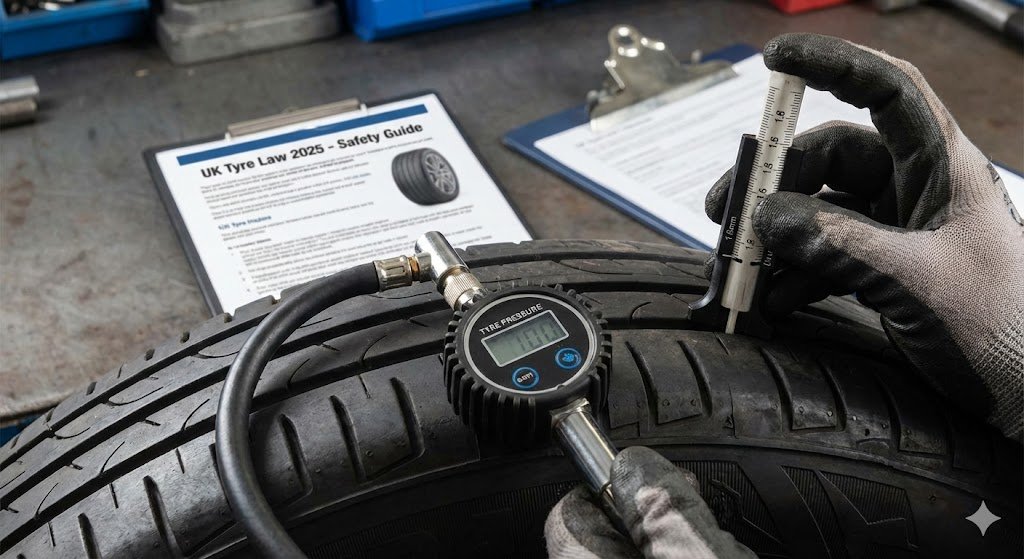
The law states that your tyres must have a minimum tread depth of 1.6mm across the central three-quarters of the tyre, around its entire circumference.
-
Below 1.6mm: The tyre is illegal. You risk a fine, points, and an MOT failure.
-
The Reality: At 1.6mm, your stopping distance in the wet increases dramatically.
The Recommended Limit: 3mm
While UK tyre law says 1.6mm is the minimum, most safety experts (and our garage) recommend changing them at 3mm.
-
Why? In heavy British rain, a tyre with 1.6mm of tread cannot shift water fast enough, leading to “aquaplaning” (where the car floats on water and you lose steering control).
How to Check: The “20p Test”
You don’t need a fancy gauge.
-
Take a 20p coin.
-
Insert it into the main grooves of the tyre.
-
The Test: If the outer band of the coin is obscured by the tyre, your tread is above the legal limit. If you can see the outer band, your tyres may be illegal. Get them checked immediately.
2. Tyre Pressure: Efficiency & Safety
Does UK tyre law mention pressure? Yes. Driving with under-inflated tyres is considered driving a vehicle in a “dangerous condition.”
Why Pressure Matters
-
Safety: Under-inflated tyres overheat and can blow out at high speeds.
-
Cost: Soft tyres create more drag. Driving with tyres just 20% under-inflated can increase your fuel consumption by 10%.
-
Wear: Over-inflated tyres wear out the middle of the tread; under-inflated tyres wear out the edges (shoulders).
Finding Your Correct Pressure
Do not just guess “32 PSI.” Every car is different.
-
Look for the Placard: It is usually a sticker inside the driver’s door jamb or inside the fuel filler cap.
-
Check the Manual: It will list pressures for “Normal Load” (1-2 people) and “Full Load” (4 people + luggage).
Tip: Modern cars (post-2014) have TPMS (Tyre Pressure Monitoring Systems). If the yellow “horseshoe” light appears on your dash, UK tyre law dictates this is an MOT fail.
![Image: A driver checking tyre pressure using a digital air pump at a petrol station.] Alt Text: Checking tyre pressures correctly to stay safe and meet UK tyre law standards.
3. Tyre Age & Cracking: The “5-Year” Guideline
Rubber degrades over time, even if the car isn’t driven. UV light from the sun makes rubber brittle.
Reading the “DOT Code”
How old are your tyres? Look for the DOT code on the sidewall. It is a four-digit number in an oval.
-
Example:
2623 -
Meaning: Manufactured in the 26th week of 2023.
Is There a Maximum Age?
For cars, UK tyre law does not set a strict age limit unless the tyre shows signs of serious cracking or bulging. However:
-
Our Advice: Replace tyres older than 5 years, even if they have good tread.
-
Caravans/Trailers: Tyres on the front steering axles of HGVs and buses must not be more than 10 years old. While this strict law applies to heavy vehicles, it is a smart rule for caravan owners too.
4. Electric Vehicles (EVs) and UK Tyre Law
As we move towards 2026, Electric Vehicles are changing the game. EVs are significantly heavier than petrol cars due to the batteries, and they deliver instant torque (power).
-
Wear Rates: EV tyres wear out 20-30% faster than standard tyres.
-
Reinforced Sidewalls: You usually need “XL” (Extra Load) rated tyres for an EV. Fitting standard tyres to a heavy Tesla or Polestar can result in a blowout and a failure to comply with UK tyre law regarding “suitability for use.”
-
2026 MOT Rules: As mentioned in our previous post, testers are now stricter on “inner edge wear” on EVs. Because of the weight, the inside of the tyre often wears down to the cords while the outside looks new. Always turn your wheel fully to check the inside edge.
For visual guides on spotting dangerous inner-edge wear on EVs, check out our tyre safety boards on Pinterest.
5. Mixing Tyres: What is Allowed?
Can you mix different brands or types? UK tyre law is specific here.
-
Cross-Ply vs Radial: You absolutely cannot mix cross-ply and radial tyres on the same axle. (Almost all modern car tyres are radial).
-
Different Brands: It is legal to have a Michelin on the left and a Pirelli on the right, provided they are the same size and load rating. However, it is not recommended as they will grip differently in the wet, causing the car to spin.
-
Summer vs Winter: You should never mix summer and winter tyres. The grip levels are totally different.
6. Frequently Asked Questions (FAQ)
Here are the most common questions UK drivers ask about UK tyre law and maintenance.
1. What is the minimum tread depth in the UK? The legal minimum is 1.6mm across the central three-quarters of the tread width and around the entire circumference.
2. What is the fine for bald tyres? You can be fined up to £2,500 and receive 3 penalty points per tyre. If all four are illegal, that is £10,000 and 12 points (loss of licence).
3. Is a spare tyre a legal requirement? No. UK tyre law does not compel manufacturers to provide a spare wheel. Many modern cars come with a “repair kit” (foam) instead.
4. If I have a spare tyre, must it be legal? Only if you use it. If it is sitting in the boot, it is not tested. If you fit it to the car, it must comply with the 1.6mm rule.
5. How often should I check my tyre pressure? We recommend checking it once a month and before any long journey.
6. Can I repair a puncture in the sidewall? No. UK tyre law (BS AU 159) states that repairs can only be carried out in the central tread area. Sidewall damage weakens the structure and is unsafe to repair.
7. Do winter tyres work in the UK? Yes. Winter tyres are not just for snow; they work better than summer tyres whenever the temperature drops below 7°C.
8. What does “XL” mean on a tyre sidewall? XL stands for “Extra Load.” These tyres have reinforced sidewalls to carry heavier vehicles, such as SUVs and Electric Vehicles.
9. My tyres have cracks in the sidewall; is this illegal? It depends on the severity. Minor surface crazing is often an advisory. Deep cracks that expose the cords or ply structure are a “Dangerous” MOT failure and illegal.
10. Do I need to replace TPMS valves? It is recommended to service the valves (replace the rubber seal and core) whenever you change a tyre to prevent leaks.
Grip is Everything
Understanding UK tyre law isn’t just about avoiding a fine; it’s about keeping you and your family safe. A bald tyre stops 10 car lengths later in the rain than a new one. That distance is the difference between a safe stop and a serious accident.
Don’t wait for your MOT to check your rubber. Use the 20p test today, check your pressures, and if you are unsure about age or cracking, let a professional look.
Need New Tyres or a Safety Check? Unsure if your tyres are legal? Don’t risk the points. Get a Quote for tyre replacement or a free visual health check at our certified centre today.