Whether you’re selling your current vehicle, looking to buy a used car, or simply trying to track down that missing MOT certificate, knowing how to access your car’s MOT details is essential. The process is quick, free, and provides a wealth of information about a vehicle’s history, safety, and roadworthiness.
Thanks to the DVSA (Driver and Vehicle Standards Agency) and DVLA (Driver and Vehicle Licensing Agency), the full MOT history of a vehicle is now publicly accessible online using just the registration number.1 This guide walks you through exactly how to retrieve your MOT car details and what critical data you should be looking for.
The Official Source: Accessing Your MOT Details
The most accurate and comprehensive source for all MOT data is the UK government’s official online service. You can access two main types of information: the current status and the full history.
1. The MOT Status Check (Quickest)
This check confirms whether the vehicle currently holds a valid MOT certificate and when that certificate expires.2
-
What you need: The vehicle’s registration number (number plate).3
-
Where to go: The GOV.UK Check the MOT status of a vehicle service.4
2. The Full MOT History Check (Most Comprehensive)
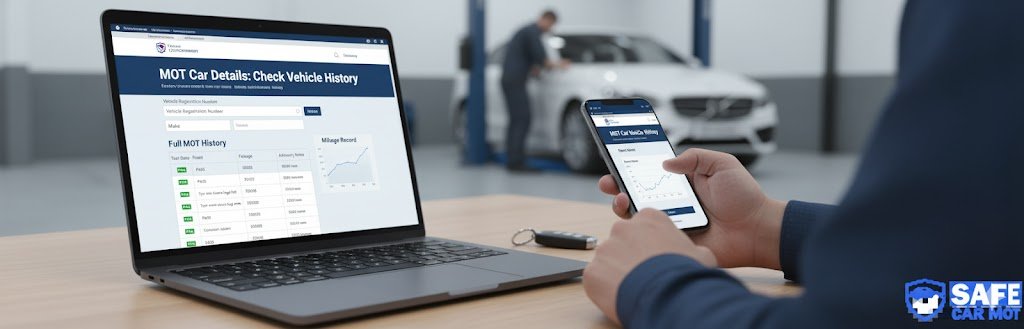
This report is the most valuable tool for owners and buyers alike. It provides a detailed chronological breakdown of every MOT test the vehicle has undergone since 2005 (for cars in Great Britain).5
-
What you need: The vehicle’s registration number.6
-
Where to go: The GOV.UK Check the MOT history of a vehicle service.7 [Outbound Link 1: Link directly to the GOV.UK MOT history page]
📋 What Vital Information Do MOT Car Details Reveal?
The history report is more than just a list of passes and fails; it is a full vehicle safety profile. Reviewing these MOT car details can save you thousands in unexpected repairs or prevent you from buying a dangerous vehicle.
A. Mileage Verification
Every time an MOT is carried out, the recorded mileage is logged.8 This creates an invaluable paper trail.
-
Why it matters: You can compare the mileage at each test date. Significant dips or sudden plateaus in recorded mileage are the primary red flags for car clocking (illegally tampering with the odometer), which is a serious fraud issue.9
B. Failures and Failure Reasons
The report details exactly why the car failed previous tests.10 Failures are now classified as Minor, Major, or Dangerous.11
-
Why it matters: A history of repeated failures on the same component (e.g., repeatedly failing on exhaust emissions or suspension) suggests a chronic underlying fault or poor past repairs.
C. Advisory Notes
Advisory notes are items that passed the test but were flagged as needing attention soon (e.g., “tyres nearing the legal limit” or “slight leak from steering rack”).
-
Why it matters: Good owners should address advisories immediately. If a car has many advisories and they reappear year after year, it shows the previous owner neglected maintenance—a critical sign when checking MOT car details.12 [Internal Link 1: Link to ‘Driving Test Vehicle Checks’ or a maintenance post]
D. MOT Certificates and Test Locations
You can view and download a copy of the current and previous MOT certificates directly from the GOV.UK service.13 You can also see where each test was done, which requires the V5C log book number for extra detail.14
3 Reasons Why You Must Check Your MOT History of a Vehicle
Checking these MOT details should be an automatic step for every motorist.
1. For Your Own Car (Staying Legal)
The most common reason for getting fined is forgetting the expiry date.
-
Solution: Use the MOT status check to instantly confirm the expiry date.15 The DVSA also offers a free text or email reminder service for your next test date.16 [Outbound Link 2: Link to GOV.UK MOT reminder service]
2. When Buying a Used Car (Due Diligence)
The MOT history is the fastest, cheapest, and most effective way to verify a seller’s claims about mileage and maintenance. Always cross-reference the history report with the vehicle’s service book. For a complete check, you should also look up the tax status using the vehicle’s registration. [Internal Link 2: Link to ‘MOT Service UK’ or a service post]
3. Identifying Safety Recalls
Depending on the manufacturer, the MOT history service may also alert you if your specific vehicle has been subject to an official safety recall that has not been addressed.17 This is a vital part of reviewing MOT car details.
💡 Quick Guide: How to Get Your MOT Car Details
| Step | Action | Required Information |
| Step 1 | Go to the official GOV.UK website. | Access via web browser. |
| Step 2 | Select the service “Check the MOT history of a vehicle.” | N/A |
| Step 3 | Enter the vehicle’s registration number (number plate). | The vehicle’s registration (e.g., AB12 XYZ). |
| Step 4 | Select the make of the vehicle from the drop-down menu. | The manufacturer (e.g., Ford, Vauxhall). |
| Step 5 | View the full MOT test results, including mileage, failures, and advisories. | N/A |
Driving with Confidence
The free access to full MOT car details has empowered UK motorists like never before. This resource removes ambiguity from vehicle sales and maintenance, allowing you to quickly verify the safety, history, and legality of any car built after 2005. Make checking the MOT history of a vehicle a standard part of your maintenance routine to ensure peace of mind on the road.