The humble MOT test is more than just an annual chore; it’s a detailed, legally mandated snapshot of a vehicle’s condition. For any car owner, especially those looking to buy or sell, accessing a vehicle’s full MOT history is one of the most powerful, free tools available in the UK motoring landscape. This comprehensive guide will walk you through exactly how to access these vital records, what the data truly means, and how leveraging this information—from mileage inconsistencies to recurring advisory notes—can save you time, money, and hassle, ensuring you always make a safe car MOT decision.
The Essential Guide to Unlocking Your Vehicle’s Past
Every single MOT test conducted in Great Britain since 2005 for cars, motorcycles, and vans (and since 2017/2018 for Northern Ireland and HGVs/trailers respectively) is logged, verified, and stored digitally by the Driver and Vehicle Standards Agency (DVSA). This creates a transparent, centralised ledger of vehicle health that is instantly accessible to the public. The ease of the MOT history check means there is absolutely no excuse for any car buyer or owner not to scrutinise a vehicle’s past. The ability to check MOT history for free, using only a registration number, has fundamentally changed the used car market, providing a powerful defence against fraud and poor maintenance.
Why Do You Need the Full MOT History? Beyond the Pass/Fail
While a current MOT certificate confirms a vehicle is roadworthy today, the full MOT history tells a deeper story. It acts as a timeline, revealing patterns of care (or neglect) that a quick look at the paintwork or a brief test drive simply cannot uncover.
| Purpose | What the History Reveals | Potential Risk Avoided |
| Buying a Car | Consistent advisories, sudden jump in mileage, recurring failures. | Buying a “lemon” with hidden, costly mechanical faults (e.g., rust). |
| Owning a Car | Tracking advisory notes from previous years to prioritise repairs. | Unexpected failure on the next test, saving on expensive urgent fixes. |
| Mileage Verification | The mileage recorded at every single test date. | Buying a “clocked” car with a manipulated odometer reading. |
| Negotiation | Evidence of poor maintenance or high-cost necessary repairs (e.g., worn subframe). | Overpaying for a vehicle whose true condition is sub-par. |
The Simple Step-by-Step: How to Access Your MOT Records
The official, most reliable, and completely free way to access MOT records is through the UK Government’s online service. You do not need the MOT certificate number, the V5C logbook, or any payment details. All you need is the vehicle’s registration number (number plate).
Step 1: Navigate to the Official DVLA MOT Portal
The DVLA MOT history service is hosted on the GOV.UK website. It is crucial to use the official government service to ensure you are getting real-time, accurate data directly from the source (the DVSA database).
Step 2: Enter the Vehicle Registration Number
On the main search page, you will be prompted to enter the vehicle’s registration number (number plate). Type it in carefully, ensuring accuracy, and then click ‘Continue’.
Step 3: Confirm the Vehicle Details
The service will instantly cross-reference the number plate and display the vehicle’s basic details, such as the make, model, and colour. This is your chance to confirm you are looking at the correct vehicle—an essential car safety check before moving on.
Step 4: Access the Full MOT History
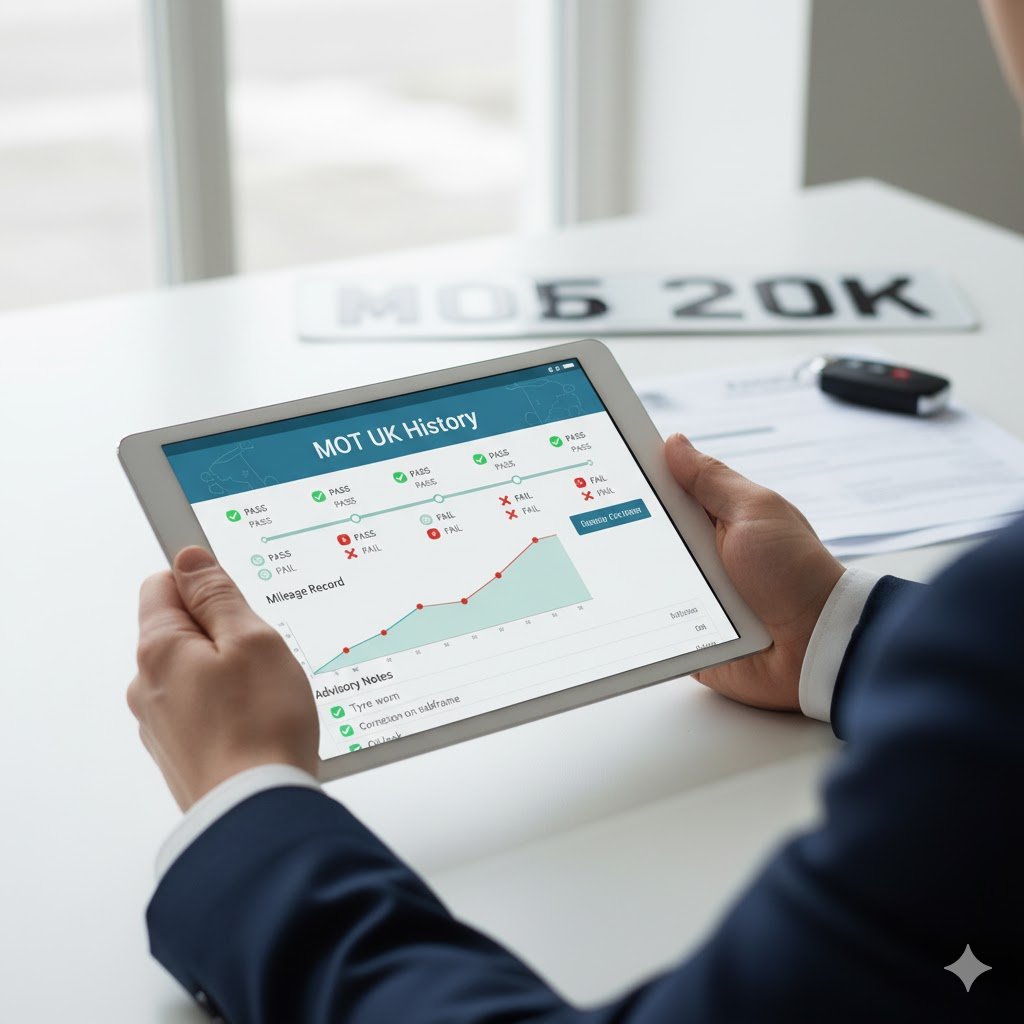
Once confirmed, you will be taken to the full record. This page is a goldmine of information, laid out in an easy-to-digest format. You can see the vehicle’s current MOT status, the expiry date, and a complete chronological list of every test conducted since 2005.
What is Included in the Full MOT Record?
When you check MOT history, the results provided by the DVSA are incredibly detailed. For each test date, you will see the following critical data points:
1. Test Result (Pass or Fail)
This is the headline—did the vehicle meet the minimum road safety and environmental standards on that day? Since 2018, failures are further categorised as:
-
Dangerous: An immediate risk. The car should not be driven until repaired.
-
Major: Affects safety or the environment. The car fails and must be repaired.
-
Minor: Does not fail the test, but must be monitored.
2. Mileage Recorded at Test
This is arguably the most important piece of data for anyone buying a used car. The mileage is recorded at every test. By looking at the pattern of mileage over the years, you can instantly spot any irregularities, such as:
-
Clocking: A sudden drop in recorded mileage compared to the previous year. This is illegal and indicates fraud.
-
Discrepancies: Large or inconsistent jumps in mileage which might not align with the car’s general condition.
3. Reasons for Failure (Major and Dangerous)
If the vehicle failed, the system lists the exact component(s) that caused the failure (e.g., “Offside headlamp seriously incorrect aim,” or “Brake fluid level significantly low”). This tells you about the types of recurring mechanical faults.
4. Advisory Notes (Minor Defects)
The advisory notes are the most revealing part of the MOT UK history. These are components that were deemed safe at the time of the test but are showing wear and will likely need attention soon.
-
Example Advisories: “Tyre worn close to the legal limit,” “Slight oil leak,” or “Corrosion to the coil spring.”
Pro-Tip: If you see the same advisory note listed year after year, it means the issue was never addressed by the owner—a major red flag for neglect.
🔎 Deeper Analysis: Using the MOT History to Spot Red Flags
Understanding the basic pass/fail is easy; the real value of the full MOT history lies in your ability to analyse the data like a professional mechanic or car dealer.
🚩 Red Flag 1: The Mileage Anomaly (Clocking)
Mileage is a huge factor in a car’s valuation. Unscrupulous sellers sometimes ‘clock’ a car—reversing the odometer reading to make the car appear less worn and command a higher price.
How to Check:
-
Look at the column titled “Mileage recorded at test”.
-
Scan down the list chronologically (from oldest to newest test).
-
If you see the mileage go down at any point, the car has been illegally clocked. Do not buy this car.
Even if the mileage is only slightly inconsistent (e.g., a massive jump followed by a tiny increase), it warrants extreme caution and further investigation. The DVLA MOT service is your primary defence here.
🚩 Red Flag 2: The Repeated Advisory Note
As mentioned, advisories are items that didn’t fail the car but need attention. If a vehicle has the same advisory note repeated across multiple years, it signals an owner who has consistently skimped on maintenance, only doing the bare minimum to scrape through the test.
What Repeated Advisories Indicate:
-
Tyres Worn Close to Limit: The owner leaves the tyres until the last legal moment, potentially driving on unsafe rubber.
-
Corrosion/Rust on Structure: If corrosion is listed repeatedly, it suggests the car has long-term structural issues that are worsening and could become a major (or dangerous) fail soon.
-
Worn Brake Components: Indicates neglect of the single most important safety system.
A history of recurring advisories should prompt you to lower your offer or walk away, as you will likely inherit a backlog of deferred maintenance. This is a critical element of any thorough car safety check.
🚩 Red Flag 3: Numerous Failures for Basic Items
A single failure is common, especially if it was a quick fix (like a blown bulb). However, a pattern of failures for easily preventable items suggests neglect:
-
Lamps/Indicators (blown bulbs).
-
Wipers/Washers (lack of washer fluid or worn blades).
-
Registration plates (unclean or illegal spacing).
These are signs of an owner who doesn’t perform even the most basic weekly checks, meaning the more complicated (and expensive) parts may also be neglected. When you check MOT history for a used car, look for quick re-tests with different failure items each time.
🛠️ Get MOT Done: Preparation and Future Proofing
The full MOT history isn’t just for used car buyers; it’s an invaluable tool for current owners to achieve a stress-free pass every single year. By using your own vehicle’s MOT record, you can adopt a proactive maintenance strategy—the best safe car MOT approach.
1. Create a “Fix-It” List from Past Advisories
Before booking your next test, review your last three MOT records. Compile a list of all advisory notes and schedule the necessary repairs.
| Past Advisory | Action Required | Cost Saving |
| Front brake pads worn | Replace pads and check discs (Minor fix). | Prevents a Major failure on the test day, avoiding re-test fees and saving time. |
| Tyre worn close to limit | Replace tyre immediately. | Avoids driving illegally on a bald tyre and prevents an immediate Major failure. |
| Suspension component worn | Have a garage inspect the suspension (Proactive fix). | Prevents the issue worsening into a Dangerous defect, which would make the car illegal to drive. |
By addressing these issues proactively, you turn potential failures into easy passes, spreading the cost of maintenance throughout the year rather than facing a massive bill all at once. This is the ultimate way to Get MOT Done smoothly.
2. Monitor Your Mileage Between Services
Use the recorded mileage to monitor your car’s usage. This helps you determine if you should opt for an annual or interim service and allows you to catch any potential mileage fraud quickly if your vehicle ever leaves your care (e.g., at a long-term parking facility or previous service garage).
3. Downloading and Storing MOT Certificates
Did you know you can download a copy of the current and previous MOT certificates from the official DVSA service?
-
To access and download the full MOT history certificates (which include more details like the test centre), you will need the 11-digit number from the vehicle’s log book (V5C).
-
Store these digital copies securely. This is especially useful when selling the car, as it provides instant, verifiable proof of maintenance.
⚖️ MOT History vs. Full HPI Check: Understanding the Difference
While the MOT history check is phenomenal for assessing the mechanical and maintenance condition of a car, it is not a complete history check. It is essential to understand the difference.
| Feature | MOT History Check (DVSA) | Full HPI/Vehicle History Check (Paid) |
| Cost | FREE | Typically £10 – £30 |
| Data Source | DVSA (DVLA) | Multiple sources: Police, Insurance Companies, Finance Houses, DVLA |
| Primary Focus | Mechanical condition, mileage, maintenance patterns. | Legal and financial status, write-off markers, theft, outstanding finance. |
| Red Flags Found | Clocking, neglect, structural rust. | Write-off history (Category S/N), stolen status, active finance agreement. |
The Bottom Line: Always perform a free MOT history check first. If the history looks clean and you are serious about buying the car, the next step must be a full HPI check to ensure the car isn’t stolen or subject to outstanding finance—risks the MOT check does not cover.
💡 Accessing Your Driving Record: A Related Personal Check
While the focus of this guide is on the vehicle’s history, it’s worth noting that the DVLA also offers services for drivers to Check Driving Record UK. This allows you to view your own licence details, including:
-
Driving entitlements (what vehicles you can drive).
-
Endorsements (penalty points) and disqualifications.
This is a separate, confidential service, but it’s part of the same digital initiative by the DVLA/DVSA to centralise driver and vehicle information. Accessing this requires your driving licence number, National Insurance number, and the postcode on your licence.
The Power of Knowledge from Your Full MOT History
The free DVSA service to check MOT history has levelled the playing field for all UK motorists. It transforms what was once a paperwork trail into an instant, transparent vehicle biography. Whether you are a first-time buyer worried about hidden problems, or a long-time owner dedicated to preventing costly surprises, leveraging these readily available MOT records is the easiest way to ensure the long-term safety, value, and roadworthiness of any car.
Make it a non-negotiable step in your car buying and ownership process. Just enter that number plate, and let the truth of the MOT UK history guide your decision.
DVLA MOT Check: How to Use the Official DVLA Service to Check MOT History
Car MOT Booking Online Everything You Need to Know About Booking MOT
My MOT Check: How to Check Your MOT History Using Your Registration Number